



Define the instruction
Supply the accounts, money forms and destination. Include the agreed conversion terms and funding evidence where required.
Banks & financial institutions
Connect deposit, payment and digital-money workflows with policy checks before release and evidence of the reported outcome. Your bank keeps its books, keys and execution systems.

 Your systems.
The work you want to do
A client may hold a bank deposit and need a payment or position in another form. The instruction, authority and reported outcome need to remain connected across the systems you configure.
Make new settlement workflows inspectable without replacing the ledger your bank relies on.
Start with a defined workflow within one institution. Cross-bank corridors require separate development and agreement between the institutions. Deposits, funding and execution remain with the bank and its providers.
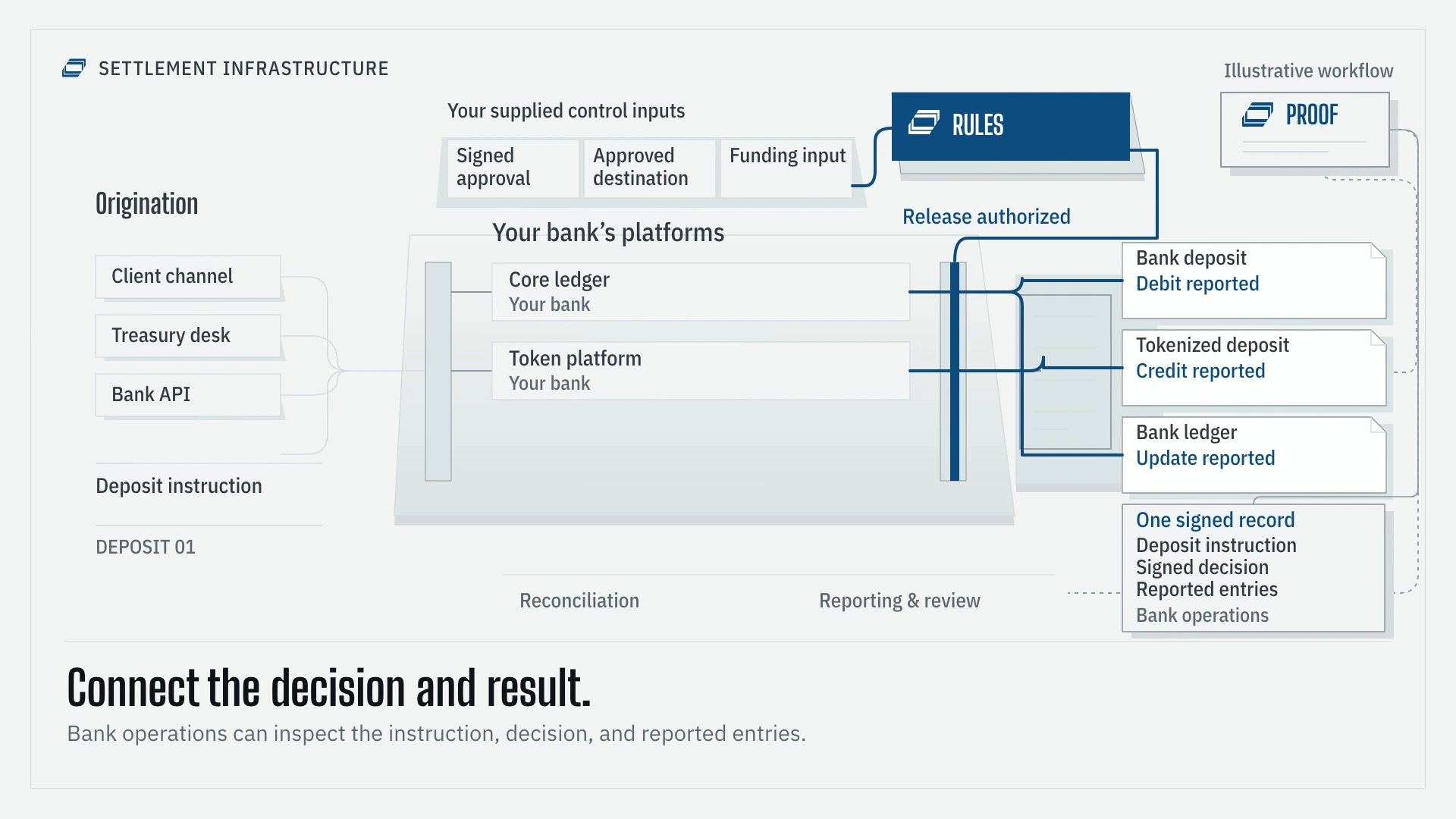
A bank supplies the deposit instruction, the approved token destination and its required checks. Its own platforms perform and report the book and token entries. Frame links the decision and results.
Supply the accounts, money forms and destination. Include the agreed conversion terms and funding evidence where required.
Frame Rules evaluates signed inputs against your bank’s policy. Your configured systems execute only an allowed instruction.
Frame Proof connects the instruction, decision and reported outcome in a record the recipient can check.
An example to scope against the bank’s actual deposit-token platform; no minting service or live cross-bank network is implied.
Your infrastructure. New possibilities.
Connect deposit instructions, your bank’s platforms and their reported entries in one workflow.
The film could not load. Read the complete workflow below, or open the video.
The core ledger and token platform you configure stay in place.
Frame Rules checks approval, destination and funding inputs.
Your bank’s platforms execute and report the entries.
Frame Proof links the instruction, decision and reported result.
Illustrative workflow within one configured institution. Your bank’s platforms execute and report the entries.
Explore your workflowYour bank receives a request to move an approved deposit amount to a tokenized-deposit position. Its core ledger and configured token platform stay in place. Frame Rules checks the supplied approval, destination and funding inputs against the bank’s release policy. The bank’s platforms execute and report the entries; the bank ledger reports its update. Frame Proof links the instruction, signed decision and reported entries in a record bank operations can inspect. This illustrates one configured institution. It does not show Frame issuing tokens or operating a live cross-bank network.
Open the filmChoose your starting point
Go deeper into the workflow, the part Frame plays and what stays with your team.
Give the issuer’s auditor checkable reserve evidence for a reporting period.
02Check and record a transfer between accounts or deposit positions inside one institution.
03Reduce the residual amount that must be funded while retaining the original obligations.
04Connect bank-held deposits with a configured fiat or digital-money settlement flow.
05Keep a grouped allocation and its release decision together when one instruction has multiple destinations.
06Make a settlement release depend on the bank’s own signed checks, limits and approvals.
07Give the receiving institution checkable evidence of the sender’s settlement decision and reported outcome.
A useful first conversation
Use sample or synthetic records for an initial demonstration. Agree any sensitive data exchange separately.
Explore the capabilities in more detail.
 Settle
 Coordinate settlement through your own systems.
Explore Frame Settle →Rules Your policy, enforced before money moves.
Explore Frame Rules →Proof A settlement receipt others can verify independently.
Explore Frame Proof →Netting Reduce the funding tied up across your accounts.
Explore Frame Netting →Before we talk
No. Your bank continues to hold the accounts and post the entries. Frame checks the instruction at release and records the decision and reported outcome.
No. An initial workflow can use bank deposits and existing payment infrastructure. Digital-money endpoints are included only where your workflow calls for them.
Each endpoint, policy and execution arrangement must be configured. A form supported by the instruction model is not a statement that every external provider is integrated.
A separately scoped issuer reserve workflow can package agreed source records for your auditor. The issuer and custodians maintain the reserves; the evidence does not by itself establish solvency or complete disclosure.
Make the next move
Tell us the instruction, the systems involved and the result your team needs to establish.