




Pair the obligations
Supply the asset and cash obligations, their obligors and the selected execution venues.
Asset & cash workflows
Keep the asset and payment obligations, governing policies and reported outcomes connected across your configured settlement arrangement.

 Your systems.
The work you want to do
The asset platform and cash platform may operate separately. The recipient needs a record of the obligations, the relevant authority and what each platform reported.
Give both sides a connected basis for checking the settlement record.
Cash-leg coordination does not make Frame a trading venue, custodian or tokenisation service. Atomic beneficiary delivery is limited to a configured supported shared venue; source escrow initiation and arbitrary cross-rail delivery are separate.
An instruction identifies the asset and cash obligations. Frame checks the applicable policy inputs; the chosen platforms report execution. The resulting evidence retains both sides.
Supply the asset and cash obligations, their obligors and the selected execution venues.
Frame checks the required policies and supplied funding inputs. Your configured platforms carry out the asset and cash execution.
Retain the instruction, policy identities and reported results for both sides in a portable evidence record.
Illustrative asset and cash instructions. Completion depends on the selected venue and configured execution systems.
Your infrastructure. New possibilities.
Connect an asset obligation and its cash payment while keeping your chosen platforms in control.
The film could not load. Read the complete workflow below, or open the video.
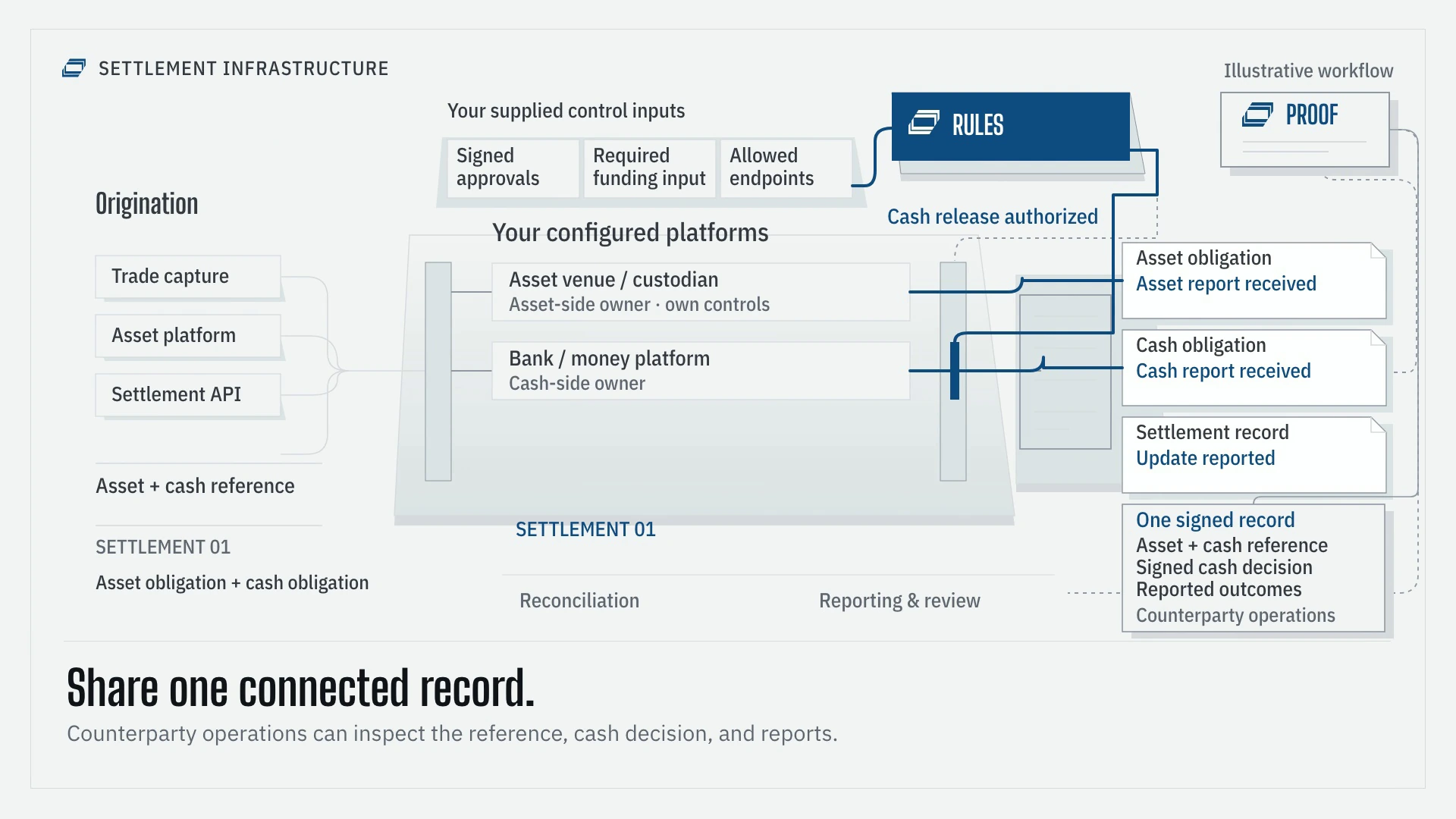
Your systems supply the asset and cash instructions under one reference.
Frame Rules checks the cash instruction and supplied release inputs.
The asset-side and cash-side platforms report their outcomes separately.
Frame Proof connects the shared reference, decision and reports.
Illustrative asset and cash instructions on configured platforms. Each party retains its own books, keys and execution.
Explore your workflowYour exchange records an asset obligation and its corresponding cash payment under one settlement reference. Trade capture, custody, the asset venue and the cash connection remain in place. Frame Rules checks the applicable cash instruction and supplied release inputs. The chosen asset-side and cash-side platforms execute under their own arrangements and report their outcomes separately. Frame Proof links the shared reference, cash-side decision and reports so a counterparty can inspect the record. The asset type and venue must be scoped; this illustration does not establish universal securities coverage, custody, or atomic delivery across different rails.
Open the filmChoose your starting point
Go deeper into the workflow, the part Frame plays and what stays with your team.
Give the issuer’s auditor checkable reserve evidence for a reporting period.
02Connect the two sides of an agreed currency exchange and make their authority and outcomes inspectable.
03Let the recipient test the supplied record independently, without a login to the venue or a call to Frame.
04Show which rule version governed a release decision and preserve evidence of stopped requests for investigation and audit.
05Keep the asset obligation, cash obligation and governing decisions together in a record both sides can inspect.
A useful first conversation
Use sample or synthetic records for an initial demonstration. Agree any sensitive data exchange separately.
Explore the capabilities in more detail.
Before we talk
No. This workflow concerns an asset obligation, its cash payment and the supplied settlement evidence. Venue-wide solvency requires a different assurance scope.
Yes. Scope the instruction and approvals needed by the cash side while keeping the asset system and its reports in place. The wider arrangement determines how both obligations relate.
No. Both-or-neither beneficiary delivery is a specific configured shared-venue capability. Do not assume it across arbitrary banks, rails or networks.
The recipient uses a portable record and independently trusted verification inputs. The homepage’s test record demonstrates an actual local verification check.
Make the next move
Tell us the instruction, the systems involved and the result your team needs to establish.