




Submit the bank instruction
Identify the accounts, parties and amount. Supply the bank’s required signed checks and funding information.
Bank settlement
Start with a settlement workflow on one institution’s books. Connect its instruction, policy decision and reported entries, then scope the evidence another institution would need.

 Your systems.
The work you want to do
An auditor or receiving institution needs to understand which instruction was authorised, under which policy and with which reported result. That record should remain inspectable outside the originating dashboard.
Make the settlement decision and reported entries portable and independently checkable.
The starting workflow shown here is within one institution. A cross-bank corridor is a separate development and participation arrangement; each endpoint retains its own books, keys and execution.
An operating account transfer passes the bank’s release policy. The bank posts its own entries, then Frame seals the decision and reported outcome.
Identify the accounts, parties and amount. Supply the bank’s required signed checks and funding information.
Frame Rules checks policy before release. The bank’s own systems execute the allowed instruction and report the entries.
Frame Proof preserves the instruction, decision and reported result for a recipient with independently trusted verification inputs.
The diagram demonstrates the current starting scope, not a live cross-bank corridor.
Your infrastructure. New possibilities.
Keep the infrastructure you trust. Add policy before release and signed evidence of the reported outcome, while your platforms execute.
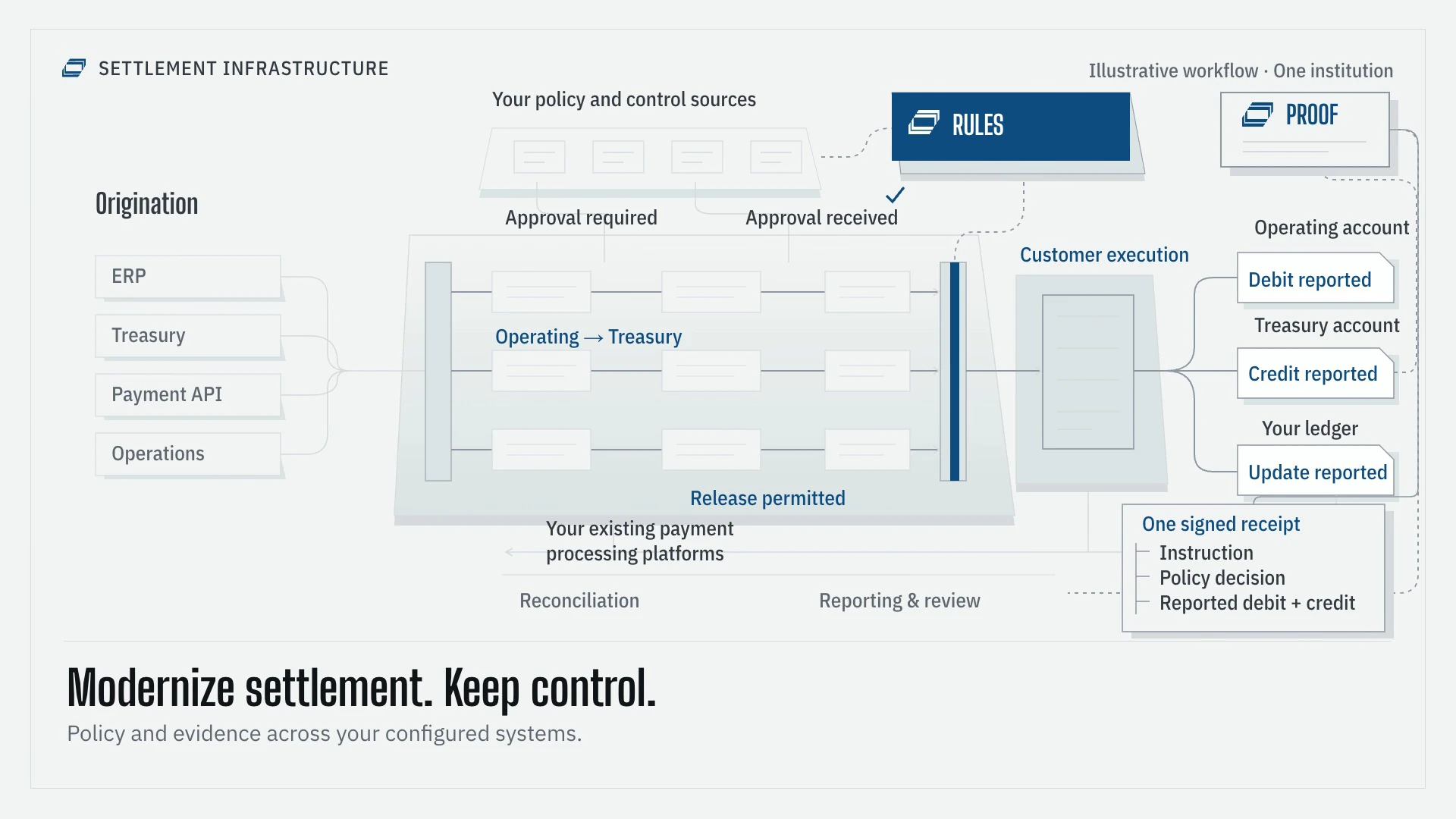
The film could not load. Read the complete workflow below, or open the video.
Start with the systems, accounts and connections you already use.
Frame Rules checks the instruction before release.
Your systems execute and report the entries on your books.
Frame Proof links the decision and reported outcome.
Illustrative transfer between accounts within one institution. Your platforms execute and report the entries.
Explore your workflowFrame adds a policy decision before release and signed evidence of the reported outcome to existing customer settlement infrastructure. Customer platforms execute and retain their books and keys. This illustrative workflow takes place within one institution. The film is silent. It follows an instruction from an operating account to a treasury account. An approval is required and received; release is then permitted. Customer execution subsequently reports a debit, a credit, and a ledger update. Frame Proof links the instruction, policy decision, and reported result in one signed receipt. The final wide view retains the completed operational details. Frame Rules supplies the policy decision; Frame Proof connects the instruction, decision and reported outcome.
Open the filmChoose your starting point
Go deeper into the workflow, the part Frame plays and what stays with your team.
Check and record a transfer between accounts or deposit positions inside one institution.
02Give the receiving institution checkable evidence of the sender’s settlement decision and reported outcome.
03Specify the policy and evidence flow between a provider’s existing endpoint institutions.
A useful first conversation
Use sample or synthetic records for an initial demonstration. Agree any sensitive data exchange separately.
Explore the capabilities in more detail.
Before we talk
Choose an own-book transfer with clear source and destination accounts. Establish its policy inputs and reported entries before widening the integration scope.
Frame supplies policy checks and evidence around the instruction. Accounts, liquidity, relationships and execution remain with the institutions and their providers.
No. Cross-bank corridors are in development. The required endpoints, participation terms and evidence flow must be scoped.
No. It makes the supplied decision and reported outcome checkable. Legal finality depends on the relevant arrangement and applicable rules.
Make the next move
Tell us the instruction, the systems involved and the result your team needs to establish.