




Define the intended outcome
Supply a source obligation and the approved destination allocation, including conversion terms where needed.
Platform settlement
Bind the allocation, release decision and reported results in a settlement workflow your configured platforms execute.

 Your systems.
The work you want to do
The source obligation, destination split, approval and provider result can live in different systems. Keeping them connected gives operations a clearer record to inspect.
Preserve the allocation and decision behind each reported settlement leg.
The workflow depends on configured endpoints, your policy and provider funding. Frame does not supply custody, FX liquidity or a universal payout network. Multiple legs do not imply atomic completion or automatic failover.
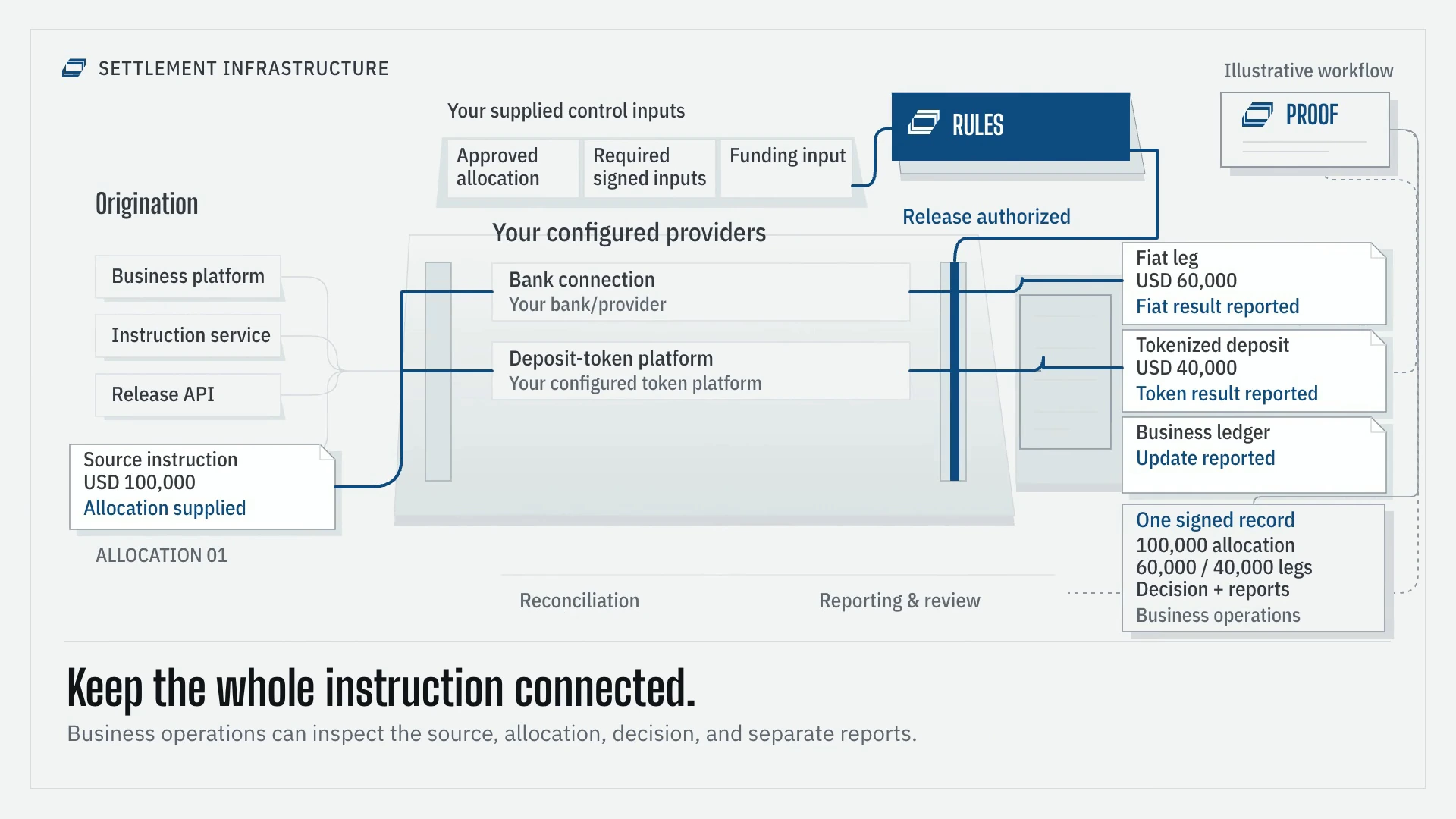
A customer instructs a USD 100,000 allocation: USD 60,000 in fiat and USD 40,000 in tokenised deposits. Its providers execute the configured legs; Frame preserves the allocation, release decision and reported results.
Supply a source obligation and the approved destination allocation, including conversion terms where needed.
Frame checks signed inputs against your release policy. Configured banks or digital-money providers carry out their parts.
Frame Proof links the source, allocation, decision and per-leg reports to the original instruction.
Illustrative allocation. Each destination requires a configured connection and its own completion conditions.
Your infrastructure. New possibilities.
Follow a supplied allocation from one business instruction to the reported result of each leg.
The film could not load. Read the complete workflow below, or open the video.
Your platform allocates $100,000: $60,000 fiat and $40,000 tokenized deposits.
Frame Rules checks the allocation and required signed and funding inputs.
Your configured providers execute and report their own legs.
Frame Proof connects the instruction, decision and reported outcomes.
Illustrative USD 100,000 allocation across configured endpoints. Each leg has its own completion conditions.
Explore your workflowYour business platform supplies a one hundred thousand dollar settlement instruction allocated as sixty thousand dollars in fiat and forty thousand dollars in tokenized deposits. Frame Rules checks the approved allocation and required signed and funding inputs before release. Your configured bank and deposit-token providers execute their own legs and report their results. Your business ledger reports its update. Frame Proof retains the source instruction, allocation, signed decision and reported outcomes. The example uses configured endpoints; multiple legs do not by themselves establish atomic delivery, automatic failover or a universal payout network.
Open the filmChoose your starting point
Go deeper into the workflow, the part Frame plays and what stays with your team.
Connect bank-held deposits with a configured fiat or digital-money settlement flow.
02Keep a grouped allocation and its release decision together when one instruction has multiple destinations.
03Make a settlement release depend on the bank’s own signed checks, limits and approvals.
04Turn the PSP’s already-calculated merchant obligations into approved and traceable settlement instructions.
05Keep one payout allocation, policy decision and reported results together across configured destinations.
06Require the PSP’s screening, approval and limit results before releasing a payout instruction.
07Connect the two sides of an agreed currency exchange and make their authority and outcomes inspectable.
08Keep the agreed FX or cross-asset conversion terms attached to the resulting settlement instruction.
09Require the agreed counterparties, limits, approvals and cutoff rules before a corridor instruction is released.
10Reconstruct who authorised a transfer and which policy governed it, including requests that were stopped.
11Make the relationship between investment value, funding and the resulting payment explicit and checkable.
12Keep the asset obligation, cash obligation and governing decisions together in a record both sides can inspect.
A useful first conversation
Use sample or synthetic records for an initial demonstration. Agree any sensitive data exchange separately.
Explore the capabilities in more detail.
Before we talk
The configured model supports source and destination forms with priced conversions where needed. Bank deposits, fiat, stablecoins, tokenised deposits and money-market fund units have distinct requirements.
No such promise is made. Your platform supplies the intended instruction and configured providers; scope any selection logic separately.
A policy refusal prevents release through the configured gate and creates a decision record. An unavailable gate pauses the workflow; it does not silently allow the instruction.
The supported fund-unit form is held on a transfer-agent register. It requires current signed fund values and configured funding and redemption arrangements; it is not a synonym for a tokenised share.
Make the next move
Tell us the instruction, the systems involved and the result your team needs to establish.