




Sign the mandate
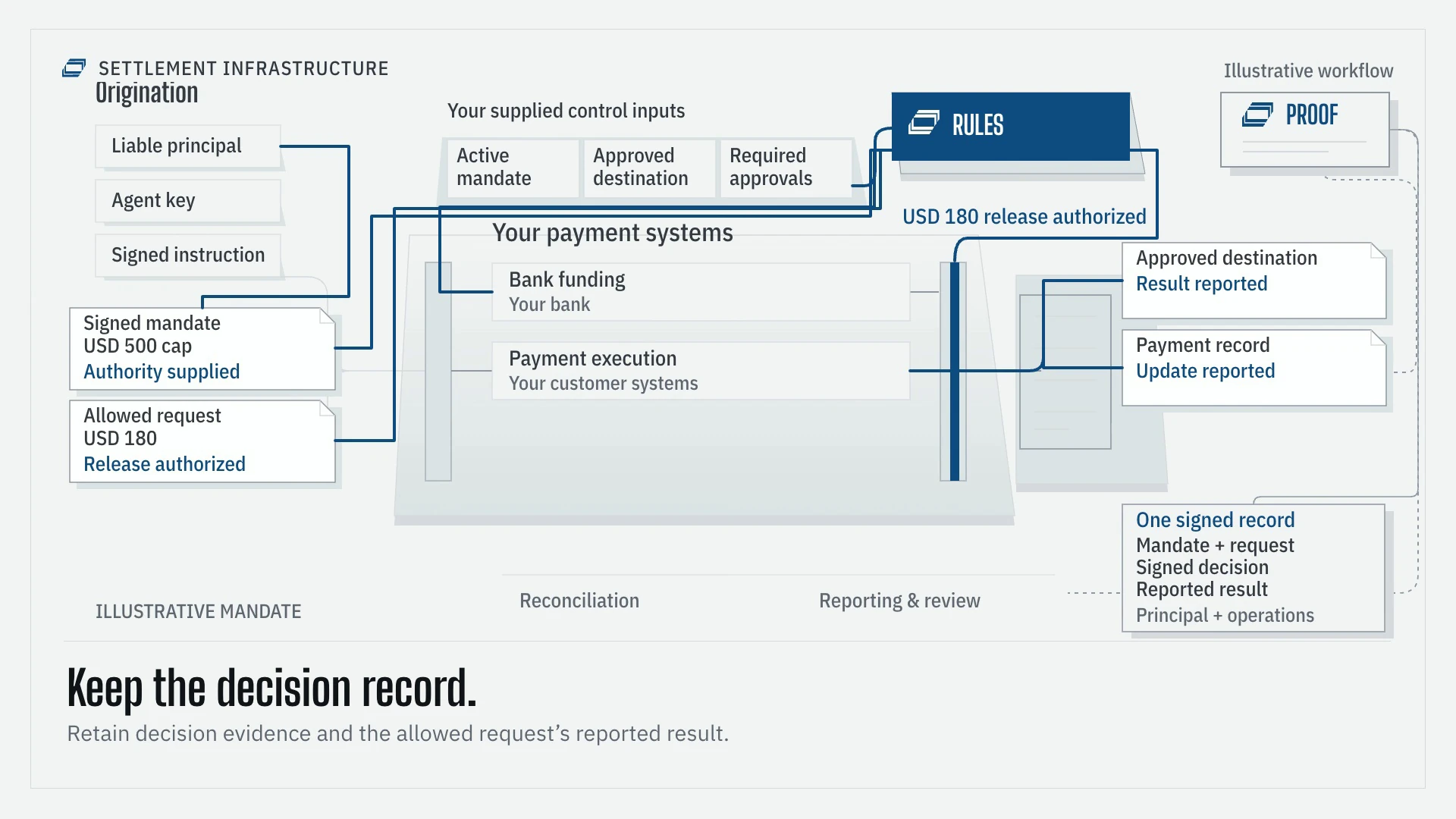
A liable principal names the delegate key, authority, limits and allowed destinations. The instruction is bound to that mandate.
Agentic payments
Give an agent bounded asking authority through a signed mandate. Apply your policy before release and retain evidence of the resulting decision.

 Your systems.
The work you want to do
An agent can propose an instruction. The principal needs to define what it may request, the bank needs to control the funding and operations need to understand why a request was allowed or refused.
Make delegated payment authority explicit and the policy decision inspectable.
This is a documented working software-mode demonstration and a workflow to scope. Frame does not determine whether an agent’s reasoning is correct. Invalid signatures, replays or revoked mandates may be rejected before a signed policy verdict exists.
The documented demo authorises a USD 180 in-mandate request and records a policy refusal for a USD 600 request. The example also has an approved destination and the other required inputs.
A liable principal names the delegate key, authority, limits and allowed destinations. The instruction is bound to that mandate.
Frame checks signed inputs and policy. Required bank-side funding checks and human approvals remain part of the configured workflow.
Your systems execute an authorised instruction. Frame seals the authorisation or a policy refusal, with the appropriate evidence.
The amount comparison illustrates one rule. It is not a live payment or a complete decision based on the amount alone.
Your infrastructure. New possibilities.
Let an agent request payments within a signed mandate, with release controlled by your policy.
The film could not load. Read the complete workflow below, or open the video.
The principal sets bounded authority, including a $500 payment cap.
Frame Rules checks the signed request and required approval and funding inputs.
Only the authorized USD 180 request reaches your payment systems.
Frame Proof retains the relevant decision evidence and reported outcome.
Illustrative signed-mandate decisions from a documented software demonstration. Amount is one of the required checks.
Explore your workflowA liable principal gives an agent bounded asking authority through a signed mandate. In this documented software demonstration, the per-payment cap is five hundred US dollars. A one hundred and eighty dollar request is bound to the active mandate and approved destination, with the required signatures, approvals and bank funding inputs. Frame Rules authorizes it, and the customer’s payment systems execute and report the result. A separate six hundred dollar request is refused by policy and does not reach execution. Frame Proof retains the relevant decision evidence. The amount is only one check. Invalid signatures, replayed requests and revoked mandates can stop a request before a signed policy verdict exists. This is not a live payment demonstration or a judgment of the agent’s reasoning.
Open the filmChoose your starting point
Go deeper into the workflow, the part Frame plays and what stays with your team.
A useful first conversation
Use sample or synthetic records for an initial demonstration. Agree any sensitive data exchange separately.
Explore the capabilities in more detail.
Before we talk
The mandate demo treats the agent as outside the trust boundary. Authority comes from the principal’s signature and the configured policy, not from the model’s identity.
No. The exact instruction, delegate signature, active mandate, destination, approvals, funds and policy checks also matter.
The documented demo includes an escalation threshold: a request requiring approval is refused until the required approval input is supplied.
A policy denial does. Invalid signatures, replayed instructions and other failures can stop a request before a signed policy decision is produced.
The documented mandate flow includes principal revocation and rejects later requests under a revoked mandate. Scope the principal and revocation controls for your deployment.
Make the next move
Tell us the instruction, the systems involved and the result your team needs to establish.