



Define the cycle
Supply eligible obligations, entities, opening liquidity, priorities and the netting agreement.
Corporates & treasury
Net eligible obligations, connect the residual to your institutional settlement systems and retain the gross record that finance needs for the close.

 Your systems.
The work you want to do
Funding each gross obligation can require more cash than funding the eligible net result. Treasury still needs to explain every original obligation, the netting cycle and the payment that remains.
Make the residual funding requirement and the obligations behind it inspectable.
Start with an institution-hosted group workflow. Eligibility, agreements and available liquidity govern the result. Finance teams, auditors and advisers decide accounting, legal and tax treatment.
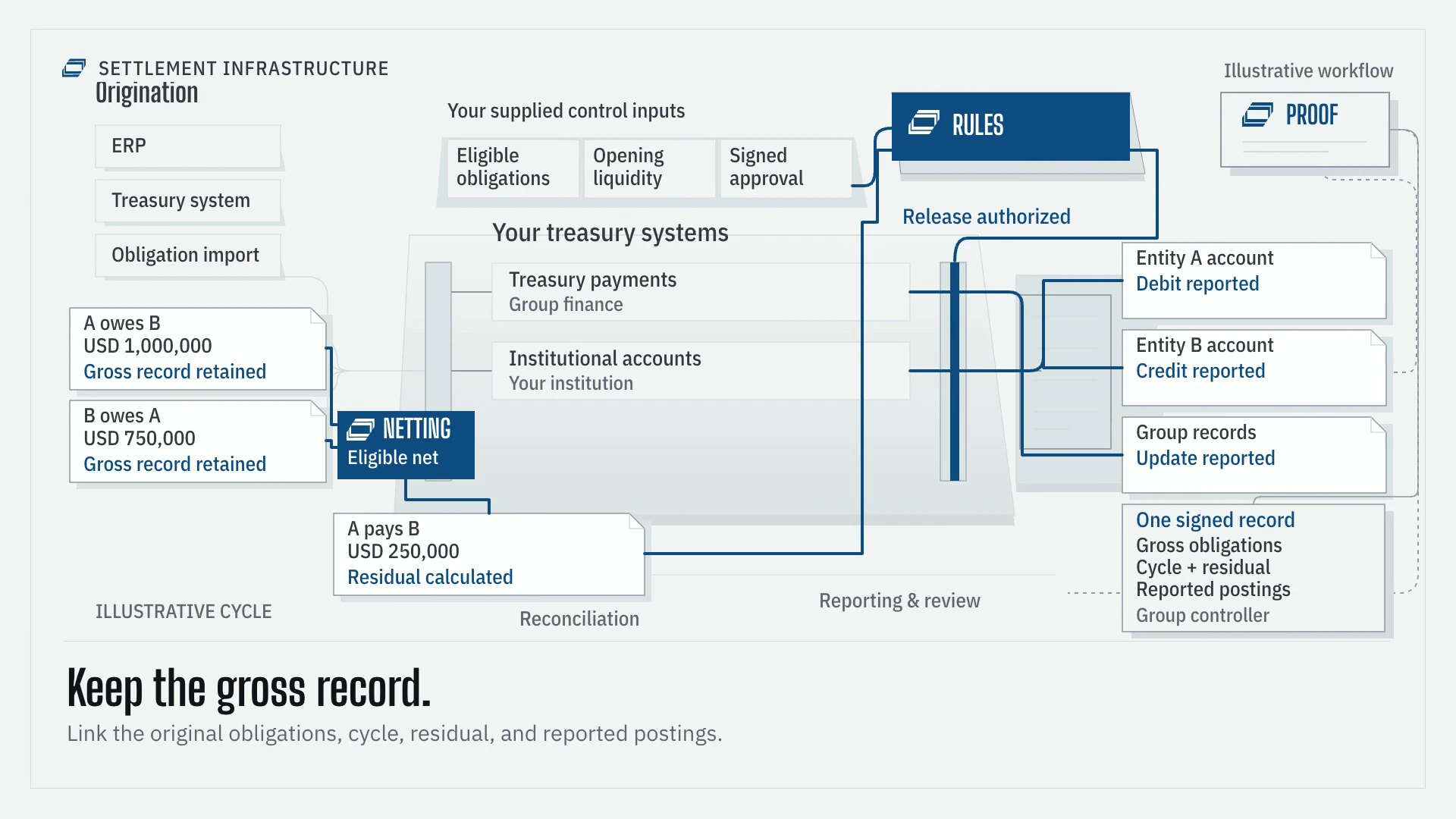
For two eligible same-currency obligations in one cycle, the arithmetic leaves a USD 250,000 residual from A to B. Both original obligations remain in the record.
Supply eligible obligations, entities, opening liquidity, priorities and the netting agreement.
Frame Netting works out a feasible net result. Your institutional systems execute the linked residual instruction under your release policy.
Keep the gross obligations, positions and reporting breakdown linked to the cycle. Your finance team applies account mappings and determines posting treatment.
Illustrative arithmetic assumes eligibility, the required agreement and adequate opening liquidity. It is not a customer savings figure.
Your infrastructure. New possibilities.
Settle an eligible net obligation through your existing systems, with the original obligations retained.
The film could not load. Read the complete workflow below, or open the video.
Your systems supply eligible obligations in the same currency and cycle.
Frame Netting calculates the residual; Frame Rules checks its release.
Your institution executes and reports the residual payment.
Frame Proof links the original obligations, residual and reported postings.
Illustrative same-currency arithmetic, subject to eligibility, agreement and opening liquidity. Your institution settles the residual.
Explore your workflowYour ERP and treasury system supply two eligible obligations in the same currency and cycle: Entity A owes Entity B one million US dollars, and Entity B owes Entity A seven hundred and fifty thousand US dollars. Frame Netting calculates a two hundred and fifty thousand dollar residual from A to B, subject to the agreement, eligibility and available opening liquidity. Frame Rules checks the residual release. Your institution executes and reports the payment; your finance team retains responsibility for its books. Frame Proof links the gross obligations, cycle, residual and reported postings. The amounts illustrate arithmetic, not measured customer savings. Accounting, legal and tax treatment remain with the parties and their advisors.
Open the filmChoose your starting point
Go deeper into the workflow, the part Frame plays and what stays with your team.
Explain the stated position with a checkable record, rather than asking the recipient to accept a dashboard total.
02Fund the resulting net outflows while retaining a verifiable account of the gross obligations behind them.
03Trace the close back to the original obligations and recompute the reported figures from the same evidence pack.
04Reconstruct who authorised a transfer and which policy governed it, including requests that were stopped.
05Make the relationship between investment value, funding and the resulting payment explicit and checkable.
A useful first conversation
Use sample or synthetic records for an initial demonstration. Agree any sensitive data exchange separately.
Explore the capabilities in more detail.
 Settle
 Coordinate settlement through your own systems.
Explore Frame Settle →Rules Your policy, enforced before money moves.
Explore Frame Rules →Proof A settlement receipt others can verify independently.
Explore Frame Proof →Netting Reduce the funding tied up across your accounts.
Explore Frame Netting →Before we talk
No. Eligible netting can work around existing obligations and institutional accounts. A digital-money endpoint is an optional configured part of a different workflow.
The cycle retains the original gross record and its relationship to the resulting positions and residual instruction. This supports reconciliation and reporting.
Your team supplies the source records and configures institutional connections. A receipt does not independently discover balances at other banks.
That depends on the eligible obligations, priorities and opening liquidity. Test a representative sample; any example on this page is arithmetic, not a promised customer result.
Make the next move
Tell us the instruction, the systems involved and the result your team needs to establish.